C.J. "Kees" Zilverschoon (1923 - 2012)
Authors/Creators
Description
C.J. was one of the first staff to join CERN, in May 1954 – when there was no laboratory and only the beginnings of an organization, which was formally founded in September 1954. Most people coming to CERN at that time left a well-established position at home, choosing (as J. B. Adams said in an interview) an ‘adventure against job safety’.
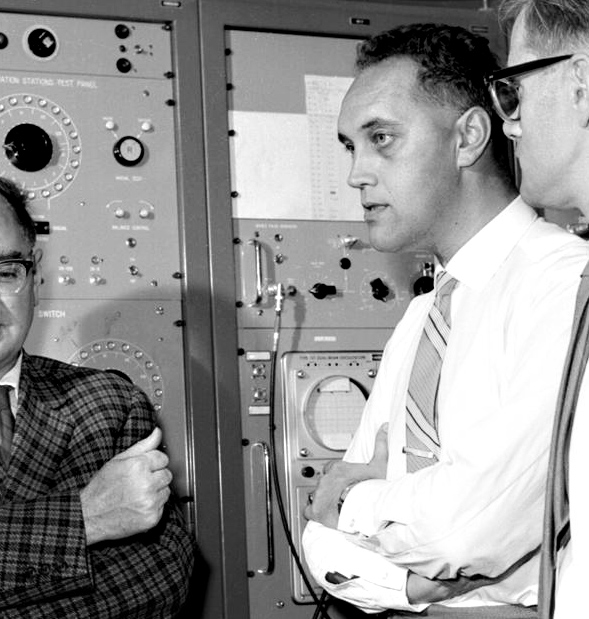
C.J. Zilverschoon in the PS Control Room, 1960. See the full version of the image (with A. Schoch and K. Johnsen) here.
Coming from the University of Amsterdam as an applied physicist, where he had worked on isotope separators, his obvious place at CERN was with the construction project of the 25 GeV Proton Synchrotron. There, he took charge of general engineering and, later, installation and the setting up an operations group. He collaborated closely with C.A. Ramm and G.L. Munday, who were in charge of the PS magnet and the vacuum system, respectively.
When the PS was finished, C.J. chose to work on developing future projects and joined the Accelerator Research Division. He was thus one of the leading figures preparing the design and cost estimate of the next large projects of CERN: the Intersecting Storage Rings (ISR) and the 300 GeV synchrotron (now SPS). There was fierce competition between the two projects for several years: whether to increase the available collision energy by building a pair of 30 GeV storage rings (ISR) or by building a 300 GeV synchrotron (now SPS).
After the Council decision in 1965 in favour of the ISR, C.J. joined it as deputy project leader while still leading, for many years, the group examining proposals from many Member States for possible alternative locations of the SPS.
While the ISR installation was finalized and commissioning started in 1970, C.J. became Director of the PS Department, where a new 50 MeV LINAC and the 800 MeV Booster were added to the PS. At the same time, he assumed the charge of Director for Programme and Budget until 1975. After this, he returned to Long-term Studies, where he was co-leader of the study of the Electron-Positron Collider (LEP), later replaced by the LHC.
He was a member of the ISR Division till 1982 and of the LEP Division till 1988, when he reached retirement age. During these years – and for a few more years during his retirement – he was Chairman of Council’s Committee in charge of the reform of the CERN Pension Fund.
Everyone appreciated C.J. as a very frank, friendly and unassuming senior colleague combining cheerfulness with a very natural authority. For more than thirty years, he was one of the leading personalities who formed CERN to become the laboratory of worldwide radiance it is today.
His colleagues and friends
Other (French)
Kees Zilverschoon fut l'un des tout premiers membres du personnel à rejoindre le CERN, en mai 1954. Il n’y avait alors pas de laboratoire. L’Organisation, qui n’en était qu’à ses prémices, n’allait voir le jour officiellement qu’en septembre 1954. La plupart de ceux qui rejoignirent le CERN à cette époque quittait un poste bien établi dans leur pays, préférant « l'aventure à la sécurité de l'emploi », pour reprendre les mots de J. B. Adams prononcés dans une interview.
C.J. Zilverschoon dans la Salle de contrôle du PS, en 1960. Découvrez la version originale de l'image (avec A. Schoch et K. Johnsen) ici.
Venant de l’Université d’Amsterdam, où il avait travaillé comme physicien appliqué sur les séparateurs d’isotopes, c’est tout naturellement qu’il fut affecté au CERN à la construction du Synchrotron à protons (PS) de 25 GeV. Il fut tout d’abord en charge de l’ingénierie générale, puis de la mise en place d’un groupe responsable de l'exploitation. Il collabora étroitement avec C.A. Ramm, responsable de l’aimant du PS, et G.L. Muday, responsable du système de vide.
Le PS terminé, il choisit de travailler au développement de futurs projets et rejoignit la division Recherche sur les accélérateurs. Il fut ainsi l’une des grandes figures à l’origine de la conception et des estimations financières des futurs grands projets du CERN : les anneaux de stockage à intersections (ISR) et le synchrotron de 300 GeV (aujourd'hui SPS). Pendant plusieurs années, la compétition fut âpre entre les deux projets : fallait-il augmenter l’énergie des collisions en construisant deux anneaux de stockage de 30 GeV (les ISR) ou construire un synchrotron de 300 GeV (l’actuel SPS) ?
En 1965, le Conseil se prononça en faveur des ISR, et Kees devint chef adjoint du projet. Parallèlement, il continua à diriger pendant de nombreuses années le groupe chargé d’examiner les nombreuses propositions des États membres concernant des lieux d’implantation envisageables pour le SPS.
Les ISR installés, leur mise en service commença en 1970 et Kees devint directeur du département PS. Un nouveau linac de 50 MeV et le Synchrotron injecteur (Booster) de 800 MeV furent ajoutés au PS. Dans le même temps, il occupa le poste de directeur du programme et du budget, jusqu’en 1975. Ensuite, il se consacra à nouveau à l’étude des projets à long terme, et codirigea l’étude sur le Collisionneur électron-positon (LEP), qui fut construit dans le tunnel où le Grand collisionneur de hadrons (LHC) vint plus tard le remplacer.
Il fut membre de la division ISR jusqu’en 1982, puis de la division LEP jusqu’en 1988, date qui marqua pour lui l’âge de la retraite. Durant cette période (et durant les premières années de sa retraite), il fut président du comité créé par le Conseil pour réfléchir sur la réforme de la Caisse de pensions du CERN.
Kees était un membre du personnel supérieur apprécié de tous pour sa franchise, son amabilité et sa modestie, et savait allier la gaieté à une autorité toute naturelle. Pendant plus de trente ans, il fut l'une de ces grandes personnalités qui constituèrent le CERN et lui permirent de devenir le Laboratoire de renommée internationale qu’il est aujourd’hui.
Ses collègues et amis
Files
Zilverschoon_image.jpg
Files
(183.4 kB)
| Name | Size | Download all |
|---|---|---|
|
md5:e2c06311412b5c2e453fee110363a172
|
183.4 kB | Preview Download |
Additional details
Identifiers
- CDS
- 1446613
- CDS Report Number
- BUL-NA-2012-164
Related works
- Is published in
- Periodical issue: nagwg-4m890 (CDS)
- Periodical issue: yt1ck-4fp86 (CDS)