Another of CERN's many inventions!
Authors/Creators
Description
CERN has often been the incubator for the development of innovative technologies but very few people know about the capacitive touch screens invented for the consoles of the SPS Control Room in 1973. The Bulletin interviewed their inventor, Bent Stumpe, who also developed the CERN tracker ball and the computer-programmable knob.
Bent Stumpe, inventor of the CERN touch screens, tracker ball and programmable knob. Here we see him with one the first touch screens developed in 1973.
In just a few days, the Danish engineer, also from the DD Division, came up with a (hand-written) proposal to build a touch screen with a fixed number of programmable buttons, a tracker ball to be used as computer-controlled pointing device and a programmable knob. Following this proposal, Bent Stumpe was recruited by the SPS Controls Group to develop the hardware.
George Shering, head of the section responsible for the development of the central controls in the SPS Division. He was one of the main developers of NODAL, the software behind the SPS control system, which included the touch screens.
Very soon, Bent Stumpe and Frank Bech were able to demonstrate that the first nine-button touch screen could really work, that is, the button pushed by the user could be reliably identified. They presented it to the Management, who accepted and supported the further development work. “In the final configuration of the SPS Control Room it was decided to install three main consoles, each equipped with a 16-button touch screen”, he says. “I have read on Wikipedia that the natural lifetime of the current touch screens is about two years. The ones we developed remained in operation for more than 20 years!”
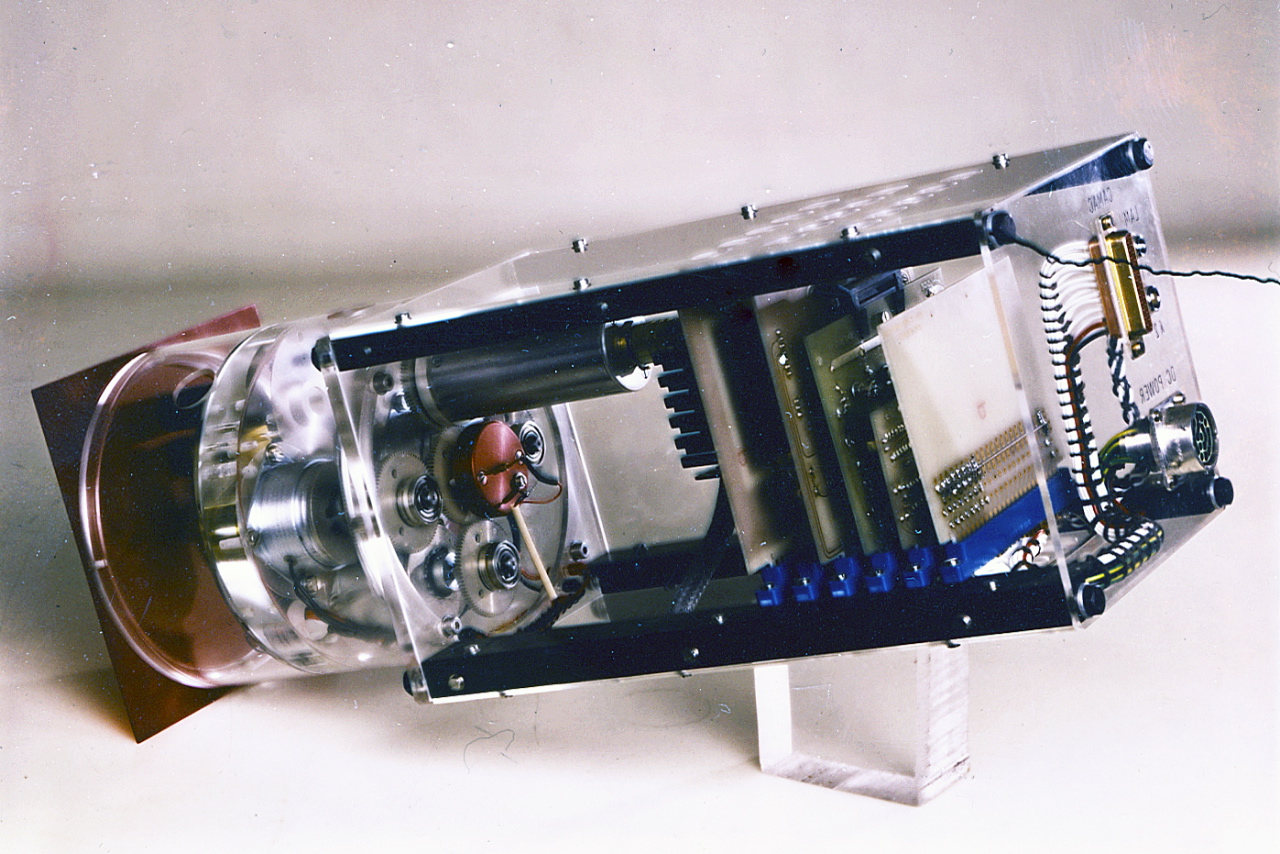
The mechanics and the electronics behind Bent Stumpe's programmable knob.
The technology developed for the capacitive touch screen was immediately transferred to industry, in particular to the Danish firm Ferroperm. At CERN the touch screen was used for a number of other control applications. CERN touch screens were also used by other big laboratories.
However, despite the numerous publications on the subject by CERN and specialist reviews, the use of touch screens was limited for a number of years partly because the system needed considerable computer power, which was very expensive at the time. Later, when computer power became cheap, the same technology was taken up again, further developed, and commercialized on the very large scale we observe today, for instance in some mobile phones.
The SPS touch-screens originally developed by Bent Stumpe were in operation from 1973 until the new LHC Control Room was installed in 2008.
How does a capacitive touch-screen work?
In a capacitive touch-screen like CERN's, the touch-sensitive area of the screen (the button) is actually part of an electric circuit. When a user touches the screen with hisfinger, he changes the dielectric of the capacitor, measurable as a change in capacitance. The software calculates the differences in capacitance relative to areas on the screen that are not being touched and identifies exactly where on the screen the change occurred. This information is then used by the software to execute the desired operation.
Further reading: CERN Yellow report.
Other (French)
Le CERN a souvent servi d’incubateur au développement de technologies innovantes, mais très peu de gens savent que les écrans tactiles capacitifs ont été inventés en 1973 pour les consoles de la salle de contrôle du SPS. Le Bulletin a interviewé leur inventeur, Bent Stumpe, qui a également mis au point pour le CERN une boule de commande et une manette de contrôle programmable.
Bent Stumpe, inventeur des écrans tactiles du CERN, de la boule de commande et de la manette programmable. Il est photographié ici avec l’un des premiers écrans tactiles développés en 1973.
En quelques jours, Bent Stumpe, un ingénieur danois qui venait également de la division DD, a proposé un projet (écrit à la main) consistant en un écran tactile comportant un nombre fixe de boutons programmables, une boule de commande servant de dispositif de pointage contrôlé par ordinateur et une manette programmable. À la suite de cette proposition, Bent Stumpe était engagé par le groupe Contrôles du SPS pour mettre au point ce matériel.
George Shering, chef de la section chargée du développement du contrôle central de la Division SPS. Il était l’un des principaux développeurs de NODAL, le logiciel derrière le système de contrôle de SPS, qui comprenait les écrans tactiles.
Bientôt, Bent Stumpe et Frank Bech ont pu démontrer que le premier écran, qui comportait neuf boutons, fonctionnait réellement, c’est-à-dire que le bouton actionné par l’utilisateur pouvait être identifié sans erreur. Ils ont alors présenté le projet à la Direction, qui l’a accepté et a lancé le travail de développement correspondant. « Dans la configuration finale de la salle de contrôle du SPS, il a été décidé d’installer trois consoles principales, chacune équipée d’un écran tactile de 16 boutons, explique Bent Stumpe. J’ai lu sur Wikipedia que la durée de vie normale des écrans tactiles actuels est de deux ans. Ceux que nous avons conçus ont continué à fonctionner pendant plus de 20 ans ! »
La mécanique et l’électronique derrière la manette programmable de Bent Stumpe.
La technologie mise au point pour l’écran tactile capacitif a été immédiatement transférée à l’industrie, en particulier à l’entreprise danoise Ferroperm. Au CERN, les écrans tactiles ont été utilisés pour d’autres applications de contrôle. Les écrans tactiles du CERN ont été également adoptés par d’autres grands laboratoires.
Toutefois, malgré les nombreuses publications sur le sujet au CERN et dans des revues spécialisées, l’utilisation des écrans tactiles a été limitée pendant de nombreuses années, en partie parce que le système exigeait une puissance informatique considérable, ce qui coûtait très cher à l’époque. Par la suite, quand la puissance informatique est devenue bon marché, la même technologie a été reprise, redéveloppée, et commercialisée à très grande échelle pour devenir omniprésente, par exemple dans les téléphones portables.
Les écrans tactiles du SPS, développés à l’origine par Bent Stumpe, ont fonctionné à partir de 1973 et jusqu’à l’installation de la nouvelle salle de contrôle du LHC en 2008.
Comment fonctionne un écran tactile capacitif ?
Dans un écran tactile capacitif comme ceux du CERN, la zone sensible au toucher de l’écran (le bouton) fait partie d’un circuit électrique. Lorsqu’un utilisateur touche l’écran du doigt, il modifie le diélectrique du condensateur, ce qui se traduit par une modification de la capacité électrique. Le logiciel calcule les différences de capacité par rapport aux zones de l’écran qui ne sont pas touchées et analyse à quel endroit de l’écran s’est produit la modification. Cette information est alors relayée au logiciel qui exécute l’opération désirée.
Plus d'infomation : CERN Yellow report.
Files
Scan20001_image.jpg
Files
(521.6 kB)
| Name | Size | Download all |
|---|---|---|
|
md5:c9f996703aa6672c9b395a48d8a98e60
|
521.6 kB | Preview Download |
Additional details
Identifiers
- CDS
- 1248908
- CDS Report Number
- BUL-NA-2010-063
Related works
- Is published in
- Periodical issue: s8f7j-9mj60 (CDS)
- Periodical issue: r3t72-hhp62 (CDS)