First detector installed inside the ALICE solenoid...
Authors/Creators
Description
ALICE's emblematic red magnet welcomed its first detector on 23 September, when the array of seven Cherenkov detectors, named HMPID, was successfully installed.
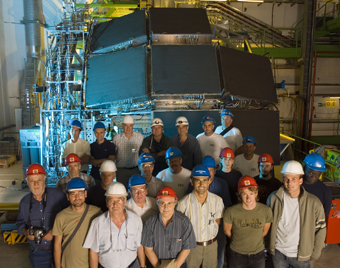
ALICE team members standing in front of the completed HMPID detector.
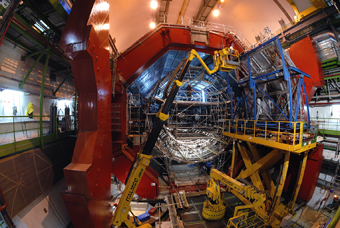
The red magnet, viewed from its front opening. The HMPID unit, seen from the back (top right corner of photo) is placed on a frame and lifted onto a platform during the installation.
After the installation of the ACORDE scintillator array and the muon trigger and tracking chambers, the ALICE collaboration fitted the first detector inside the solenoid. The HMPID, for High Momentum Particle Identification, was installed at the 2 o'clock position in the central and most external region of the space frame, just below the solenoid yoke. It will be used to extend the hadron identification capability of the ALICE experiment up to 5 GeV/c, thus complementing the reach of the other particle identification systems (ITS, TPC and TOF).
The HMPID is a Ring Imaging Cherenkov (RICH) detector in a proximity-focusing configuration, employing liquid C6F14, circulated and purified in a closed loop as radiator medium. The Cherenkov photons are converted into electrons by a thin (300 nm) layer of caesium iodide (CsI), sensitive to UV photons. This layer is deposited on the cathode, segmented into 8x8 mm2, of a multi wire proportional chamber. The 161280 pads of the detector are individually read out by two ASIC chips, GASSIPLEX and DILOGIC, developed under Jean Claude Santiard's (CERN Microelectronics Department) supervision.
The particle identification system, realised by the Bari University and INFN, CERN and INR-Moscow, is approximately 8 metres wide by 8 metres tall, and weighs about 5 tonnes. It has been segmented into seven identical modules and shaped to fit against two sides of ALICE's eight-sided octagonal magnet.
Each of the seven RICH modules, fully equipped with electronics, was separately transported to Point 2 in Saint-Genis-Pouilly, where ALICE is based, and then mounted on the support structure (cradle). After assembly, the completed HMPID was lowered down the ALICE cavern and inserted into its final position inside the magnet. Three months of planning ensured that the transport and installation processes were accomplished smoothly within a few hours.
Caesium iodide is a highly hygroscopic chemical compound and any contact with moisture would destroy the thin photosensitive layer. Therefore, during the production and assembly phases, as well as during the transport, manipulation and installation, the detector was constantly flushed with high purity argon under controlled conditions. Methane will be used during the operation of the detector.
With an active area of about 11 m2 covered with CsI, the HMPID is the largest application of this technology so far. This development started at CERN within the RD26 project under the leadership of Francois Piuz (CERN), now retired. It took fifteen years of research and development to master the method to the current scale and efficiency. During the construction phase the project was led by Eugenio Nappi (INFN Bari, Italy). In August 2006 Paolo Martinengo (CERN) took over the leadership and he will lead the project during the commissioning and exploitation phase.
In the meantime the first modules of the Time of Flight (TOF) and Transition Radiation Detector (TRD) have been lowered into and installed in the ALICE cavern. The Photon spectrometer (PHOS) will soon be installed, before the spectacular displacement of the Time Projection Chamber (TPC) takes place at the end of November.
See also the article about the history of this detector (Bulletin No. 40/2002).
Other (French)
L'emblématique aimant rouge d'ALICE a accueilli son premier détecteur le 23 septembre, lorsque le HMPID, un réseau de sept détecteurs Tchérenkov, a été installé avec succès.
Des membres de la Collaboration ALICE devant le détecteur HMPID complet.
L'aimant rouge, vu depuis son ouverture frontale. L'unité HMPID, vue de derrière (en haut à droite de la photo), est placée sur un cadre et levée sur une plateforme au cours de l'installation.
Après avoir installé le réseau de scintillateurs ACORDE et les chambres de déclenchement et de trajectographie du spectromètre à muons, la Collaboration ALICE a monté le premier détecteur à l'intérieur du solénoïde.
Le détecteur HMPID (High Momentum Particle Identification) a été positionné sur 2 heures dans la région centrale et la plus extérieure de la structure spatiale, juste au-dessous de la culasse du solénoïde. Il permettra d'étendre jusqu'à 5 GeV/c la capacité d'identification des hadrons de l'expérience ALICE et, ainsi, de compléter la portée d'autres systèmes d'identification de particules (ITS, TPC et TOF).
Le HMPID est un détecteur Tchérenkov à focalisation annulaire (RICH), reposant sur le principe de la focalisation de proximité, qui emploie du C6F14 liquide comme milieu radiateur, circulant dans une boucle fermée, dans laquelle il est purifié. Les photons Tchérenkov sont convertis en électrons grâce à une fine couche (300 nm) d'iodure de césium (CsI), sensible aux photons ultraviolets. Cette couche est déposée sur la cathode, segmentée en 8 x 8 mm2, d'une chambre proportionnelle multifils. La lecture individuelle des 161280 damiers du détecteur est assurée par deux puces ASIC, à savoir GASSIPLEX et DILOGIC, qui ont été mises au point sous la direction de Jean-Claude Santiard (département de microélectronique du CERN).
Le système d'identification de particules, réalisé conjointement par l'Université de Bari et l'INFN, par le CERN et par l'INR-Moscou, mesure environ 8 mètres de large et 8 mètres de haut, et pèse environ 5 tonnes. Il a été segmenté en sept modules identiques et a été conçu pour s'adapter à deux côtés de l'aimant octogonal d'ALICE.
Chacun des sept modules RICH, entièrement équipés d'électronique, a été transporté séparément au Point 2, à Saint-Genis-Pouilly, où est située ALICE, puis monté sur la structure de support (berceau). Une fois assemblé, le HMPID complet a été descendu dans le hall souterrain d'ALICE et inséré à son emplacement définitif à l'intérieur de l'aimant. Il aura fallu trois mois de planification pour que le transport et l'installation se déroulent sans problème, en l'espace de quelques heures.
L'iodure de césium est un composé chimique hautement hygroscopique; le moindre contact avec l'humidité aurait pour effet de détruire la fine couche photosensible. Ainsi, au cours des phases de production et d'assemblage, et durant le transport, la manipulation et l'installation, de l'argon de grande pureté a été injecté en permanence dans le détecteur dans des conditions contrôlées. Lors de l'exploitation du détecteur, du méthane sera utilisé.
Avec une surface active d'environ 11 m2 recouverte d'iodure de césium, le HMPID est à ce jour l'application la plus importante de cette technologie. Sa réalisation a débuté au CERN dans le cadre du projet RD26, sous la direction de François Piuz (CERN), aujourd'hui à la retraite. Quinze ans de travaux de recherche et de développement auront été nécessaires pour maîtriser la méthode et l'appliquer aujourd'hui avec une telle ampleur et un tel degré d'efficacité. Au cours de la phase de construction, le projet a été dirigé par Eugenio Nappi (INFN Bari, Italie). En août 2006, Paolo Martinengo (CERN) a pris la responsabilité du projet, qu'il dirigera pendant les phases de mise en service et d'exploitation.
Dans l'intervalle, les premiers modules des détecteurs à temps de vol (TOF) et à rayonnement de transition (TRD) ont été descendus et installés dans le hall souterrain d'ALICE. Le spectromètre à photons (PHOS) sera bientôt installé, avant le déplacement spectaculaire de la chambre à projection temporelle (TPC), prévu pour la fin de novembre.
Voir également l'article retraçant l'histoire de ce détecteur (Bulletin n° 40/2002).
Files
na-2006-153_0609018_05-web.jpg
Files
(312.2 kB)
| Name | Size | Download all |
|---|---|---|
|
md5:c96b75271eb54f9970bce1373cb89886
|
157.5 kB | Preview Download |
|
md5:9222d62d116c406a5f801607ad731744
|
154.6 kB | Preview Download |
Additional details
Identifiers
- CDS
- 995649
- CDS Report Number
- BUL-NA-2006-153
- Aleph number
- 000043800MMD
Related works
- References
- Other: 000043662 (Other)