Lift-off for World Year of Physics
Authors/Creators
Description
Over 1000 participants, including eight Nobel Prize Laureates, personalities from the world of science and close to 500 students from 70 countries took part in the "Physics for Tomorrow" conference at UNESCO headquarters in Paris on 13 January 2005. The event marked the official launch of the International Year of Physics, proclaimed by the United Nations. The International Year aims to highlight the importance of physics and its contribution to the development of many other scientific disciplines. It is also to help fight the current lack of enthusiasm for sciences among young people. Throughout 2005, events will be organized across the world to debate physics and it implications to society.
The conference was organized by UNESCO, the lead UN organization for the International Year, and by the physics community, in particular by CERN, CNRS and CEA, EU Commission, EPS, IUPAP and others.
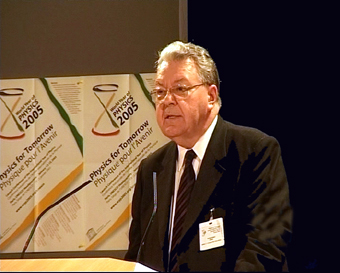
CERN Director-General, Robert Aymar, participating to the Inauguration Session of the Launch Event of the International Year of Physics.
CERN's involvement in the event started with a contribution by the Director General to the opening ceremony, followed by the participation of Carlo Rubbia in the Round table on "What can physics bring to the socio-economical challenges of the 21st century" and the talk of Georges Charpak about "Teaching and education in physics".
During the launch of the "Year of Physics", the Director General emphasised the following three messages:
- Physics is a crucial driving force for innovation in our societies;
- Science brings nations together in fair partnerships, attracting and training the most talented people;
- Sciences and derived technologies provide for the basis of the global Knowledge Society of tomorrow.
The event provided another opportunity for closer relations between CERN and UNESCO, one of the observer organizations to the CERN Council. As the 50th anniversary celebration highlighted, CERN was founded under the auspices of UNESCO in 1954 and the two organizations share a number of common goals such as advancing the understanding of nature, bringing nations together by science and training young people from many nations in science and technology for the benefits of all.
Many students attended the launch of the International Year of Physics which aims, among other objectives, to rekindle interest in this science amongst young people.
Other (French)
Plus de mille participants, dont huit prix Nobel, des personnalités du monde scientifique et près de 500 étudiants de 70 pays ont pris part à la conférence « Physique pour l'avenir » au siège de l'UNESCO à Paris le 13 janvier 2005. Cette manifestation marquait le lancement officiel de l'Année internationale de la physique proclamée par les Nations Unies. Cette Année internationale vise à souligner l'importance de la physique et sa contribution au développement de nombreuses autres disciplines scientifiques. Elle devrait aussi aider à lutter contre l'actuelle désaffection des jeunes pour les sciences. Pendant toute l'année 2005, des manifestations seront organisées dans le monde entier pour débattre de la physique et de son incidence pour la société.
La conférence a été organisée par l'UNESCO, en sa qualité d'agence chef de file des Nations Unies pour cette année internationale, et par la communauté de la physique, en particulier le CERN, le CNRS, et le CEA, la Commission de l'Union Européenne, l'EPS, l'UIPPA et d'autres organismes.
Le Directeur général du CERN, Robert Aymar, à la séance inaugurale du lancement de l'Année internationale de la physique.
Le CERN a contribué à cette manifestation, tout d'abord par un discours du Directeur général à la cérémonie d'ouverture, puis par la participation de Carlo Rubbia à la table ronde sur le thème « Les réponses possibles de la physique aux défis socio-économiques du XXIe siècle » et par l'exposé de Georges Charpak sur « Enseignement et formation en physique ».
A l'occasion du lancement de l'Année de la physique, le Directeur général a mis en exergue les trois messages suivants :
- La physique est un moteur fondamental de l'innovation dans nos sociétés ;
- La science rassemble les nations dans des partenariats équitables, et elle attire et forme les meilleurs talents ;
- Les sciences et les technologies qui en découlent jettent les bases de la société du savoir mondiale de demain.
Cette manifestation a donné également l'occasion de resserrer les liens entre le CERN et l'UNESCO, l'une des organisations qui ont le statut d'Observateur au Conseil du CERN. Comme cela a été souligné lors des cérémonies du cinquantenaire du CERN, celui-ci a été fondé sous les auspices de l'UNESCO en 1954 et il partage avec cette organisation un certain nombre d'objectifs, notamment de faire progresser la connaissance de la nature, de rapprocher les nations grâce à la science et d'assurer la formation scientifique et technologique des jeunes de nombreux pays pour le bénéfice de tous.
De nombreux étudiants assistaient au lancement de l'Année internationale de la physique dont l'un des objectifs est de relancer l'intérêt pour cette science auprès des jeunes.
Files
na-2005-008_Auditorium.jpg

Additional details
Identifiers
- CDS
- 816160
- CDS Report Number
- BUL-NA-2005-008
- Aleph number
- 000034708MMD